
What are Ants?
Ants belong to the family Formicidae, and with over 12,400 species worldwide, they rank among the most widely distributed creatures on earth. California alone hosts roughly 200 species.
Out in nature, ants are key contributors to ecosystem balance: they aerate soil, break down organic material, and regulate other insect populations.
The problem is when they move into your kitchen.
Ants are intensely social insects. Every colony runs on a caste system built around a single queen, with thousands of worker ants executing a constant cycle of foraging, nest-building, and brood care.
They communicate entirely through chemical signals called pheromones, which means the moment one scout finds food in your home, it lays an invisible trail back to the nest, and the rest of the colony follows.
That is why ant invasions feel sudden and relentless, and why they do not go away on their own.
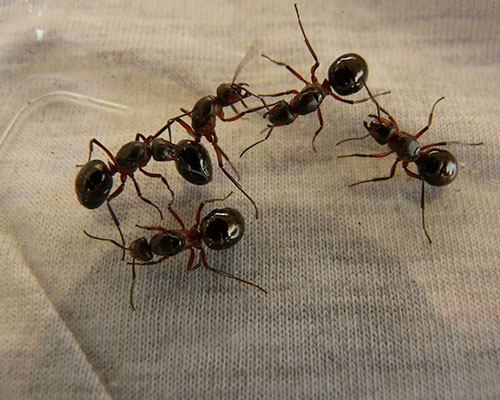
How to Identify Ants
All ants share the same basic blueprint: six legs, three body segments (head, thorax, and abdomen), elbowed antennae, and a narrow, pinched waist called a petiole.
Size and coloring vary quite a bit between species. Once you know which ant you are dealing with, you can choose a treatment that actually works.
In the San Francisco Bay Area, you are most likely to encounter one of these:
- Argentine ants (Linepithema humile): Small (1/8 inch), light to dark brown. It’s the most common household ant in Northern California. What makes it so difficult to get rid of Argentine ants is their colony structure: rather than fighting neighboring colonies, they join them, forming supercolonies that can span entire city blocks.
- Carpenter ants (Camponotus spp.): Large (1/4 to 1/2 inch), typically black or black-and-red. These ants tunnel through wood to build nests, which makes them a serious structural concern, particularly in the older wooden homes throughout the Bay Area and Sonoma County.
- Odorous house ants (Tapinoma sessile): Small (1/8 inch), dark brown to black. If you crush them, they release a sharp, rotten-coconut smell. They nest in wall voids and are drawn to anything sweet or moist.
- Pavement ants (Tetramorium immigrans): Small (3/16 inch), dark brown to black. They nest in cracks in concrete, under pavers, and along foundations. You will often spot their work as tiny mounds of fine soil pushed up through pavement cracks.
Behavior and Diet of Ants
The queen sits at the heart of every ant colony, buried deep in the nest with one job: laying eggs.
She has been doing it for years, sometimes decades, producing thousands of new workers over her lifetime.
Those workers handle everything else: foraging, nest maintenance, brood care, and colony defense.
The worker ants you see marching across your counter are almost certainly sterile females. The males exist solely to mate with new queens and die shortly afterward.
Ants are opportunistic omnivores. Depending on the species and the season, they eat sugars, proteins, fats, seeds, fruit, and dead insects.
Inside your home, they target spills, crumbs, grease, and pet food.
Argentine ants actively farm aphids on garden plants, protecting them from predators in exchange for their honeydew, which can cause significant damage to your ornamental plants and fruit trees.
While most parts of the country get a break from ants in winter Bay Area and Central Coast do not.
Winter rains flood underground nests and push ants inside for dry ground. Summer heat waves send them indoors searching for cooler temperatures and water.
This means that ants are active year-round, which is why keeping them under control in this area can be so difficult.
What Damage Do Ants Cause?
Carpenter ants can cause significant structural damage.
They hollow out wood to build nesting galleries, targeting beams, subflooring, wall voids, and window frames.
They prefer moist or damaged wood to start, but a thriving colony will move into sound timber as it grows.
The real problem is that they work entirely behind your walls, out of sight, and you might not discover the damage until it is already serious and costly to repair.
Argentine ants wreak havoc in gardens by protecting aphid colonies from natural predators, which causes aphid populations to thrive and accelerates damage to plants, shrubs, and fruit trees.
Pavement ants gradually erode the soil beneath driveways, patios, and foundations, causing cracking and settlement over time.
Ants that crawl through garbage or decaying matter can carry bacteria onto your food prep surfaces. Pharaoh ants are known to spread pathogens like Salmonella when they forage through kitchens and pantries.
What are the Signs of an Ant Infestation?
1. Ant Trails
A steady, organized line of ants moving between a food source and a wall crack or floor gap is a reliable sign of an active colony nearby.
Even if you wipe the trail away, it will reappear within hours, because the pheromone highway that guides them is still intact.
2. Nests and Mounds
Outdoors, look for small mounds of loose soil near your foundation, beneath pavers, along walkways, or tucked under rocks and garden debris.
Indoors, check for nests in wall voids, beneath flooring, and in moist areas around plumbing fixtures.
3. Sawdust-Like Frass
Fine, sawdust-like material accumulating near baseboards, door frames, or window sills is a telltale sign of carpenter ant activity.
If you also notice wood that sounds hollow when tapped, or faint clicking sounds inside walls, call a pest control professional, like Smith’s Pest Management, before the damage gets worse.
4. Winged Ants Indoors
Winged ants inside your home signal that a nearby colony has matured and is producing reproductives ready to start new colonies.
This means the infestation is large and established.
Tip: Not sure if it’s termites or winged ants? Ants have bent antennae and a narrow waist, while termites have straight antennae and a thick waist.
How to Prevent Ants
To keep ants from coming into your home, follow these simple steps:
- Clean up crumbs and spills immediately, especially in the kitchen and dining areas.
- Store food, including pet food, in airtight containers. Keep ripe fruit in the refrigerator.
- Fix leaky faucets and pipes right away, and check under sinks and around appliances for slow drips.
- Seal cracks, gaps, and openings around windows, doors, pipes, and your foundation with caulk or weatherstripping.
- Keep shrubs, mulch, and organic material at least 12 to 18 inches back from your foundation.
- Remove firewood stacks and debris piles from around your home’s perimeter.
- Trim tree branches and shrubs away from your roofline to eliminate aerial entry points.
How Smith’s Can Help Get Rid of Ants
Once ants are inside, sprays alone will not solve the problem. Only professional ant control service reaches the colony and eliminates the source.
At Smith’s, we inspect your property, identify the species, locate the colony, and apply targeted baits and non-repellent treatments that workers carry back to wipe out the nest.
Ready to get rid of ants for good? Contact Smith’s Pest Management today for a quote: (408) 871-6988